Why Node Sync Latency Is a Business Problem
For latency-sensitive trading systems, node sync latency directly affects revenue and execution quality. If your node is late, your system is more likely to act on stale blockchain state, which leads to:
-
lower execution success rate because transactions are constructed from outdated state
-
more failed simulations and more wasted compute on opportunities that have already changed
-
fewer profitable arbitrage and MEV captures because competitors see and react first
-
higher stale state risk across balance checks, pool reads, route selection, and risk controls
For searchers and arbitrage systems, this usually means seeing opportunities later, pricing them later, and losing more races to competitors who are already working from fresher chain state. For quant trading firms and trading bots, it means the strategy pipeline starts from outdated inputs, which increases failed simulations, weakens decision quality, and lowers execution efficiency.
In the above cases, the core issue is the same: even if the strategy logic is strong, stale blockchain state reduces the odds of turning speed into actual PnL.
What Is BSC Node Stream
BSC Node Stream is a low-latency node synchronization service for teams that rely on their own local BSC nodes. Unlike a standard block subscription, it is not just an external data feed. It lets your node establish a direct P2P connection with BlockRazor’s BSC nodes, so your node can receive and sync data faster through BlockRazor’s Blockchain Edge Fabric.
In other words, it is designed to solve the stale-state problem at the node layer, so your simulations, strategy logic, and execution pipeline can start from fresher chain state.
Why Standard RPC Node Sync Is Not Enough
Standard RPC is usually enough for reading chain data or consuming confirmed blocks, but not for systems that depend on the earliest possible local state. If the underlying sync path is slow, your whole execution pipeline starts late.
In short, fast trading logic cannot fully compensate for slow node sync. The practical difference looks like this:
Without Node Stream, your local node depends on ordinary sync paths, which means new blocks may arrive later than they do for competing systems. As a result, strategy engines, simulations, and risk checks start from stale state more often, and profitable opportunities may decay before your execution pipeline can react.
With Node Stream, your local node establishes a direct P2P connection to BlockRazor’s BSC nodes, so node data arrive earlier through an optimized sync path. That means your local state updates sooner, simulation and execution begin earlier, and your system has a better chance of reducing stale state risk and winning latency-sensitive races.
Benchmark: Sync Advantage After Connecting to Node Stream
The core capability behind BSC Node Stream comes from BlockRazor’s Blockchain Edge Fabric.
In node synchronization scenarios, Blockchain Edge Fabric is not just about raw network acceleration. It improves how quickly user nodes receive critical node data through high-quality node paths, regional topology selection, and real-time network condition optimization. As a result, user nodes connected through BlockRazor Node Stream can receive blockchain updates earlier and sync faster.
We benchmarked this across four regions: Dublin, Frankfurt, Tokyo, and Virginia, comparing nodes connected to Node Stream with nodes not connected to Node Stream.
The evaluation was based on each node’s block reception logs. We compared the time difference between when the two types of nodes received the same new block, in order to measure how much BSC Node Stream improves local node synchronization speed.
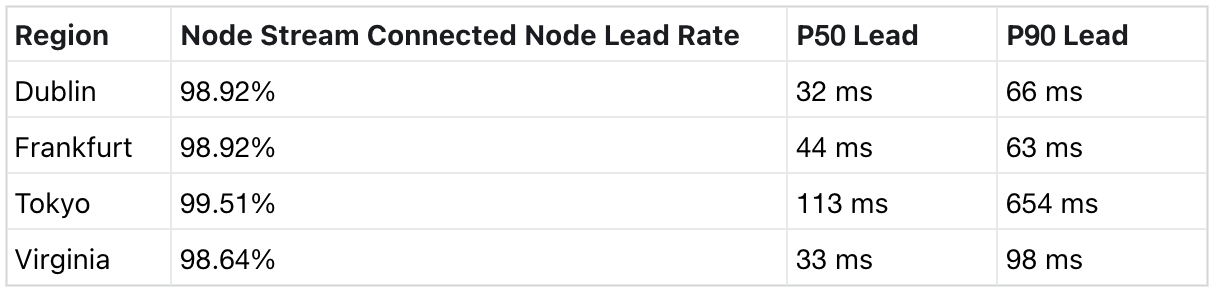
From the results, nodes connected to Node Stream showed a consistent advantage across all four regions. Based on matched block samples, the Node Stream Connected Node Lead Rate reached 98.92% in Dublin, 98.92% in Frankfurt, 99.51% in Tokyo and 98.64% in Virginia.
This means that in the overwhelming majority of comparable samples, nodes connected to Node Stream received new blocks earlier and therefore synced node data faster.
In terms of lead time, the median advantage across the four regions was approximately 32 ms in Dublin, 44 ms in Frankfurt, 113 ms in Tokyo and 33 ms in Virginia. At the P90 level, the lead widened to 66 ms in Dublin, 63 ms in Frankfurt, 654 ms in Tokyo and 98 ms in Virginia.
For trading systems that rely on local node states, these time differences translate directly into earlier state visibility and more timely strategy decisions.
Who Is It For
BSC Node Stream is best suited for teams whose business outcome depends on having the freshest possible local blockchain state, rather than teams that only need an external data feed.
Primary customer profiles include:
-
Searchers and arbitrage systems: teams competing for time-sensitive MEV and arbitrage opportunities where earlier state visibility can directly improve capture rate and profitability
-
Quant trading firms and trading bots: systems that depend on fresh local state for strategy evaluation, simulation, risk controls, and transaction construction
-
Infra and node teams: engineering teams responsible for node deployment, synchronization, connectivity optimization, and infrastructure stability across latency-sensitive products
-
Wallets, DEXs, and on-chain service platforms: teams that want their own nodes to sync the latest data faster and provide fresher data to upstream trading or user-facing services
This service is less relevant if your system only needs standard RPC reads or low-latency access to confirmed block data without running your own latency-sensitive node logic, where Block Stream is usually sufficient. If your core requirement is that your own local node must sync node data as quickly as possible, then BSC Node Stream is the better fit.
Get Started
You can purchase Node Stream from the subscription page and then follow the user guide to complete Relay Enode configuration, port opening, TrustedNodes setup and connection status verification. If you want to evaluate it first, you can start with a day-based purchase option, connect your own node, and run your own benchmark against your current setup to compare block arrival timing and local sync speed before committing longer term.
Once your local node can sync node data faster, your team can further combine this with BlockRazor’s transaction submission capabilities, such as RPC, Block Builder, or Fast. Node Stream improves the speed of underlying node state updates, while transaction submission services optimize how transactions enter the execution path. Together, they form a more complete low-latency on-chain trading infrastructure.
'%3e%3cpath%20d='M24.2162%2049.7297L33.2973%2041.9459L48%2039.3513L24.2162%2049.7297Z'%20fill='%23FFFFF2'/%3e%3cpath%20d='M26.95%2033.1959L29.0127%2035.2586L17.2973%2052.3243L39.3513%2032.8648L35.027%2028.9729L49.2973%2012.5404L15.5676%2022.4864L39.7838%2018.1621L26.95%2033.1959Z'%20fill='%23FFFFF2'/%3e%3c/g%3e%3cdefs%3e%3cclipPath%20id='clip0_124_13500'%3e%3crect%20width='55.3514'%20height='64'%20fill='white'%20transform='translate(8.64862)'/%3e%3c/clipPath%3e%3c/defs%3e%3c/svg%3e)