
I. Introduction: The MEV Dilemma Behind Solana’s High Performance and the Emergence of Solutions
Positioned as a high-performance DeFi infrastructure, Solana’s drive for extreme performance has shaped a unique MEV landscape distinct from the EVM ecosystem. MEV, defined as the profit gained by reordering, censoring, or inserting transactions during block production, is amplified in Solana’s high-frequency trading environment. Consequently, this has sparked serious debate over the fairness of transaction ordering and the privacy of user transaction.
Jito, as a pioneer of MEV infrastructure on Solana, has optimized MEV capture and distribution to some extent by introducing bundle and validator client. However, Jito’s transaction ordering rules lack transparency, support for special trading needs like those of market makers is insufficient, and it fails to address malicious MEV behaviors such as sandwich attacks resulting from private mempools and validator malfeasance. These issues expose the limitations of a single MEV solution.
It is against this backdrop that emerging projects like Paladin, BAM, and Harmonic have arisen. With different technical routes and governance philosophies, they attempt to challenge the existing landscape, providing fairer, safer, or more efficient block building solutions.
II. Comparison of MEV Governance Strategies and Technical Routes
This section will delve into the core philosophies, MEV governance strategies, and technical routes of Harmonic, BAM, and Paladin to reveal their unique paths in solving the Solana MEV dilemma.
Paladin
Paladin’s core philosophy is to reshape the trust environment of Solana transactions through economic mechanisms that “make honesty more profitable than cheating,” creating more sustainable revenue for validators and providing users with a fair transaction path free from malicious MEV infringements (such as sandwich and front-running attacks). It ensures the fairness and privacy of user transactions by receiving high priority fee transactions and filtering out malicious ones.
Regarding its technical route, according to the GitHub repository paladin-solana, Paladin is a modified version of the Jito validator and has not proposed a completely new architecture or mechanism technically. Paladin introduces the P3 (Paladin Priority Port) port, allowing users to send high priority fee transactions directly to the Leader, aiming to avoid front-running.
The PAL token plays multiple roles in the Paladin ecosystem. A portion of P3 priority fees will flow to PAL, making it collateral that supports Paladin’s robustness and value. It is primarily a cash flow token and limits access to P3 through token-gating, further enhancing its value and incentivizing honest validator behavior. However, analysts point out that P3 may merely tokenize existing functions and could lead to transaction flow fragmentation, with limited improvement to network capabilities.
BAM (Blockspace Assembly Markets)
BAM’s core philosophy lies in building a “verifiable private transaction scheduling system” by separating transaction ordering from validation. It aims to fundamentally eliminate the space for malicious MEV, emphasizing transaction privacy and deterministic execution.
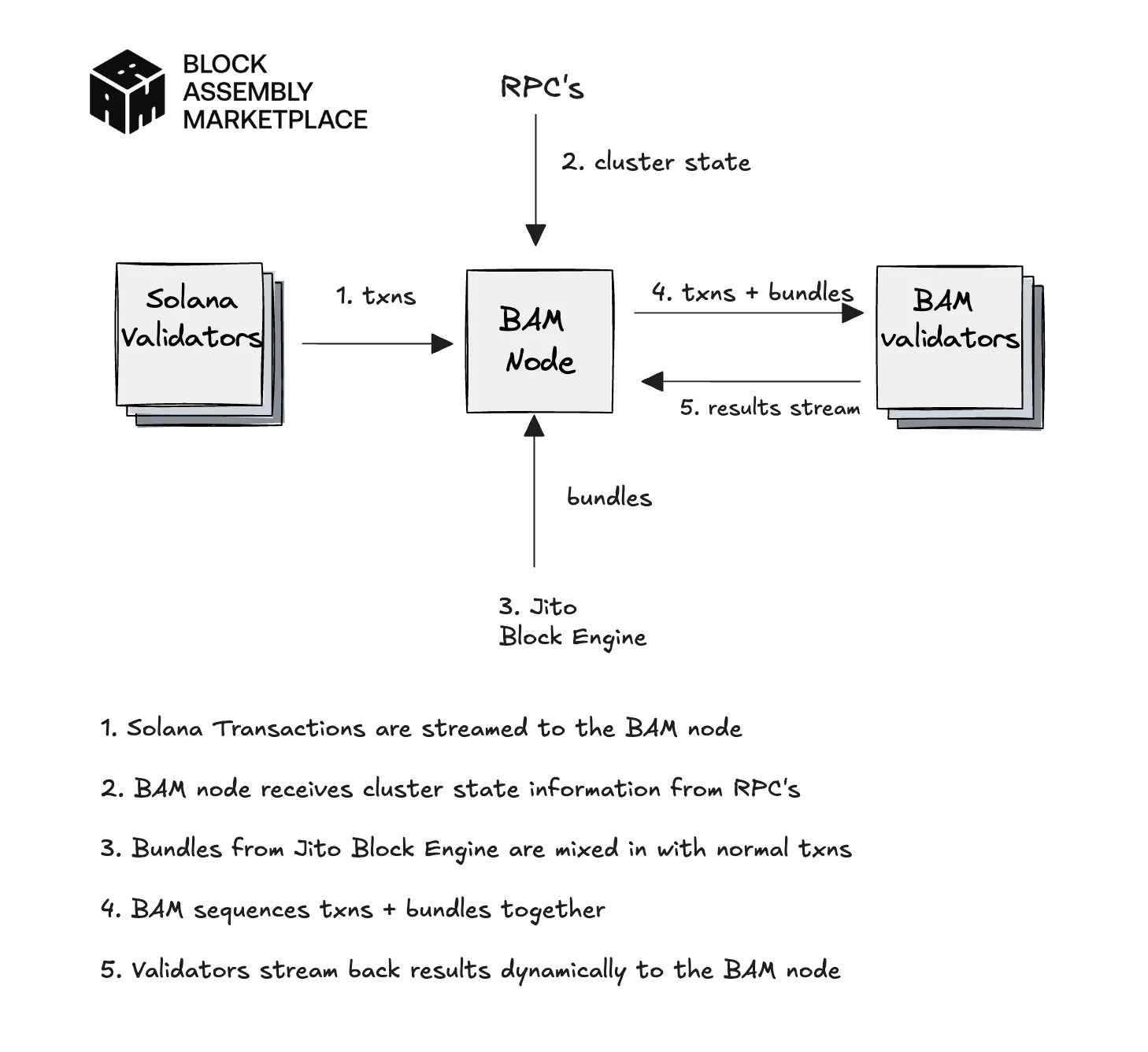
In terms of technical route, BAM introduces the BAM Node as a centralized scheduler responsible for ingesting and validating transactions, strictly ordering them according to preset rules, and then sending them as micro-blocks to the Leader BAM Validator. Its key technical breakthrough lies in utilizing the AMD SEV-SNP Trusted Execution Environment (TEE), ensuring transaction privacy during the ordering process. TEE technology ensures that even in a malicious environment, transactions can be ordered within an isolated, trusted execution space, thereby effectively preventing malicious MEV behaviors such as sandwich attacks and front-running.
BAM’s plugin system (ACE) further empowers Solana application developers, enabling them to customize transaction execution guarantees, ordering logic, and specific functions to drive the innovation and development of upper-layer applications. BAM has proposed the inaugural AEC plugin on its forum, which enables DeFi and other trading applications to implement transaction speedbumps in a permissionless manner. This mechanism is designed to safeguard market makers from being picked off on stale quotes by aggressive takers.
Notably, the BAM client is compatible with existing validator infrastructure like Jito-Solana, of which the transactions could be pre-processed and ordered through the BAM system.
Harmonic
Harmonic’s core philosophy is dedicated to establishing an open block building infrastructure on Solana, breaking the centralization trend of the existing MEV supply chain by introducing multi-Builder competition. It firmly believes that open, fair market competition can bring “higher validator revenue potential, better market structure, and stronger decentralization,” explicitly stating that a “fast and fair market is superior to a fast but closed system.”
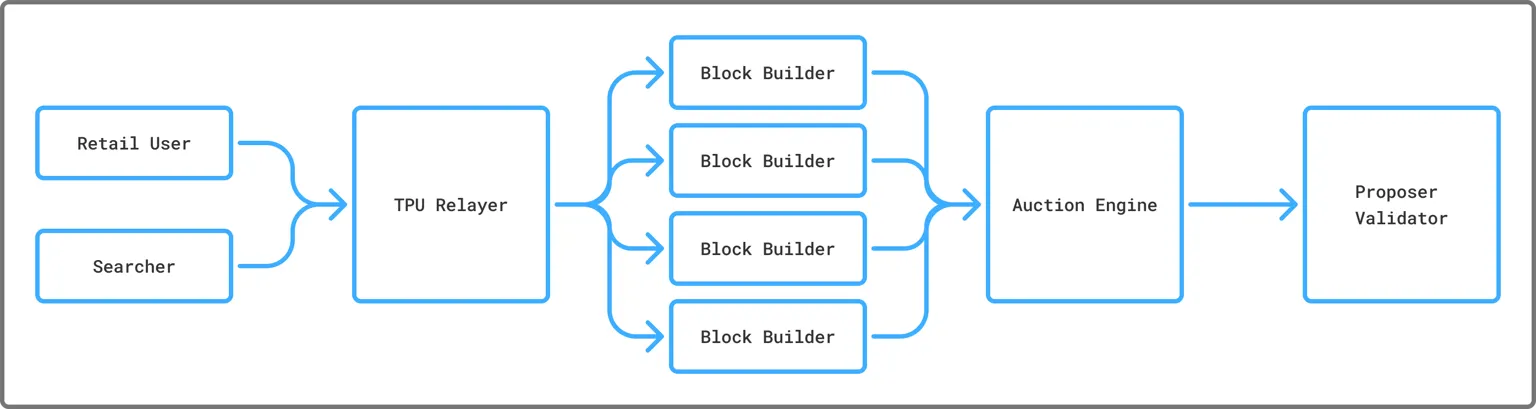
Regarding its technical route, Harmonic adopts a market-based block auction mechanism, aggregating and auctioning blocks submitted by multiple independent block builders. This design allows validators to flexibly choose the block included in each slot based on their own preferences and strategies, thereby enhancing validator autonomy. By allowing validators to choose from blocks submitted by third-party block builders, Harmonic aims to maximize validator revenue and give them greater control over block content. This open competition model is expected to improve market efficiency and reduce reliance on single-builder solutions.
III. Validator Client Comparison
This section will quantitatively compare Paladin, Harmonic, and BAM across three dimensions: market share, validator revenue, and performance metrics.
Market Share and Validator Client Distribution
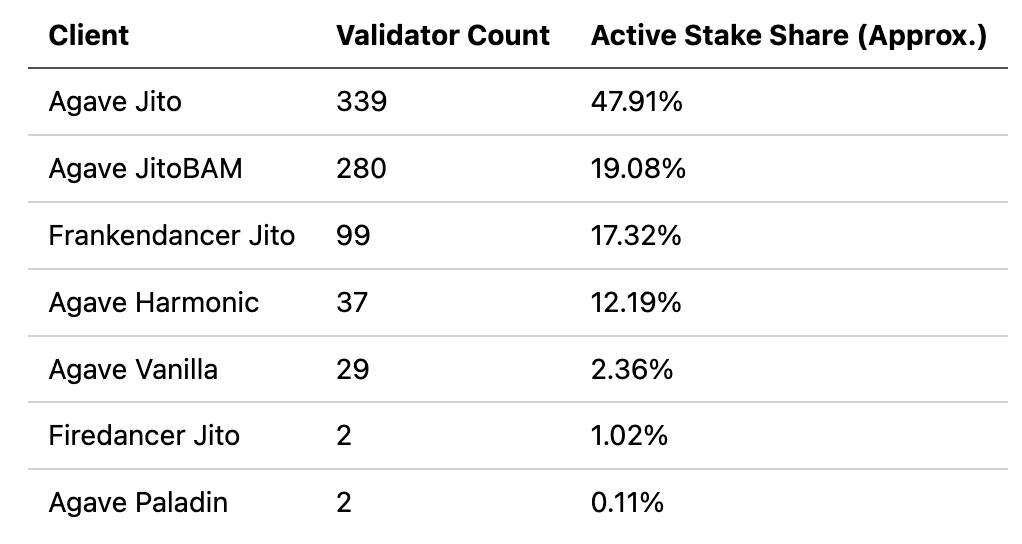
From the data above, it can be seen that Jito clients (including Agave Jito and Frankendancer Jito) still occupy the vast majority of the market share for Solana validator clients.
Paladin (Agave Paladin) has the smallest market share with only 2 validators. As of now, the Paladin official website is inaccessible, and X operations have ceased. Its GitHub repositories p3-standalone, paladin-solana, and p3-txn-sender show minimal activity, reflecting potential challenges in market promotion and ecosystem building.
BAM (Agave JitoBAM) leads relatively among emerging competitors with 280 validators.
Harmonic (Agave Harmonic) has 37 validators; although fewer in number, it is actively promoting open block building.
Validator Revenue Analysis
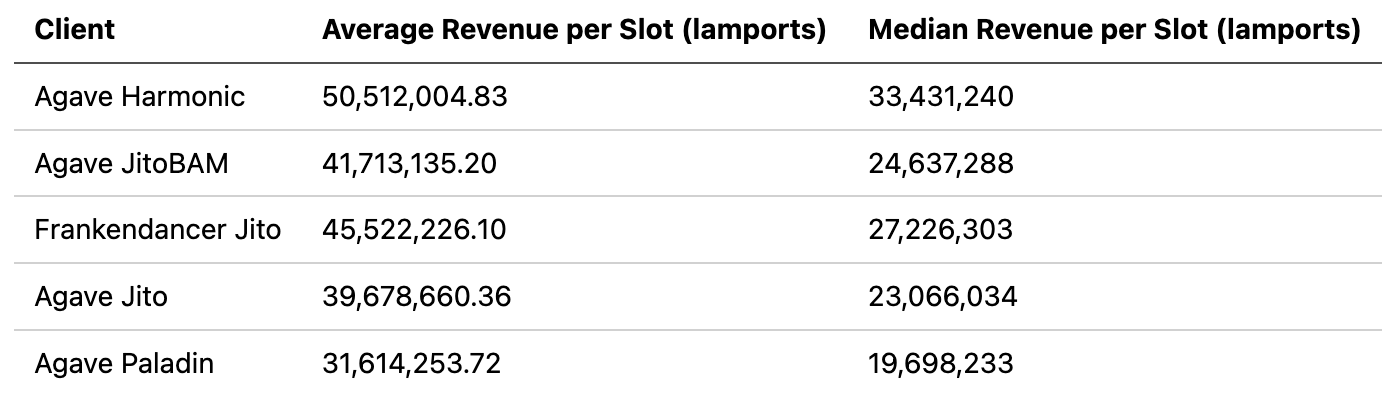
From the validator revenue data, the Paladin client has the lowest revenue among the three competitors, which may be related to its smaller market share and insufficient project activity.
The BAM client performs well in revenue; due to its compatibility with Jito and the launch of a subsidy program, its validators can obtain substantial tip shares and additional incentives.
Harmonic client’s average and median revenue per slot rank the highest among all clients, aligning with its core philosophy that “block competition brings enhanced revenue for validators.”
Performance Metrics Comparison
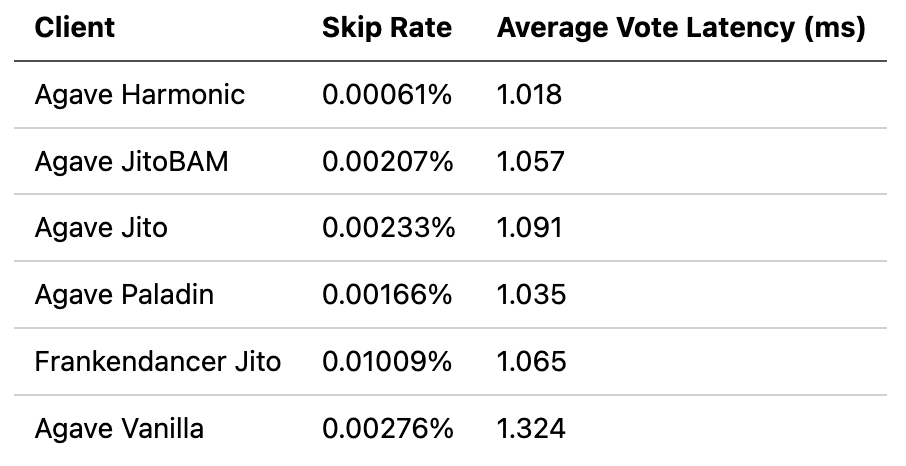
In terms of performance metrics, the Jito client has relatively higher skip rates and vote latency. Performance data for BAM and Paladin are also relatively stable, both superior to the Agave Vanilla client, but slightly lagging behind Harmonic.
The Harmonic client demonstrates the lowest skip rate and lower average vote latency, indicating excellent performance in block production efficiency and stability, which matches its philosophy that “a fast and fair market is superior to a fast but closed system.” However, it is important to note that since there is no public disclosure confirming Harmonic's integration with third-party block builders, its performance edge may stem primarily from the high-frequency trading (HFT) expertise of its team members. In the long run, performance advantages derived purely from engineering implementation do not necessarily signify the inherent superiority of a technical routing.
For validators, client selection extends beyond mere absolute yields and performance metrics. It requires a holistic evaluation of yield sustainability, the stability of incentive models, and the ability to strike an optimal balance between profitability, performance, and security.
IV. Impact Analysis on the Overall Solana Ecosystem
The development of Harmonic, BAM, and Paladin not only affects validators’ economic interests and client choices but also has a profound impact on the decentralization, innovation drive, and transaction fairness of the Solana network.
Decentralization vs. Centralization
- Paladin’s Economic Incentive Model: Paladin relies on the value of the PAL token and token-gating to incentivize honest validator behavior. This economic incentive mechanism indirectly affects decentralization. Its goal is to make the value of staked PAL by validators far higher than the gains from malfeasance, thereby encouraging validators to maintain integrity. However, the issuance and distribution methods of the token, as well as its liquidity in the market, may have complex effects on decentralization.
- BAM’s TEE Solution: BAM enhances transaction privacy and finalty through TEE, but at the cost of introducing a centralized scheduler, the BAM Node. This design solves the malicious MEV problem at the technical level but may introduce new trust assumptions or potential centralization risks, specifically trust in the TEE providers and the BAM node operators. While BAM’s TEE infrastructure is built upon the latest generation SEV-SNP architecture, it has been proven vulnerable to exploitation in laboratory settings. Known attack vectors include RMPocalypse (2025, CVE-2025-0033) and StackWarp (2026, CVE-2025-29943), among others. Another significant concern involves the possibility of BAM node operators selectively tampering with transaction packets at network ingress and egress points. Furthermore, analysts argue that the BAM mechanism effectively strips validators of their block production autonomy; as validators receive pre-ordered transactions for strict FIFO (First-In-First-Out) execution, the fundamental necessity of decentralized validators is increasingly called into question.
- Harmonic’s Open Competition: Harmonic’s multi-Builder competition model aims to fundamentally enhance decentralization and censorship resistance, reducing the power of single entities. By distributing block building rights to multiple independent parties, Harmonic helps avoid monopolies on transaction ordering by a single builder. However, it should be noted that this model is similar to Ethereum’s PBS mechanism, and issues like competition for private transactions could similarly manifest in Harmonic.
Innovation and Application Development
- Paladin’s Technical Limitations: As a modified version of the Jito client, Paladin has not proposed new architectures or mechanisms technically. Its main innovation lies in the economic incentive model and the P3 port, which limits its direct contribution to underlying technology and application-layer innovation. Low project activity may also limit its influence on ecosystem innovation.
- BAM’s ACE Plugin System: BAM’s ACE plugin system provides a unique sandbox environment for application-layer innovation, encouraging developers to innovate based on customized execution logic. This means developers can design customized transaction ordering rules and execution guarantees for specific applications, thereby unlocking new use cases and user experiences.
- Harmonic’s Open Market: Harmonic’s open market will attract more Builders to join, promoting innovation in MEV strategies and block building technologies. Competition among different Builders will drive technological progress, generating more efficient and innovative MEV capture strategies and block building algorithms. While introducing market-based competition, analysts point out that Harmonic has transitioned block building from 'streaming' to 'discrete' intervals. This shift renders the infrastructure incapable of supporting real-time high-frequency trading (HFT) applications.
Balancing Transaction Fairness and MEV Incentives
- Paladin’s Economic Incentive Defense: Paladin attempts to resist malicious MEV through economic incentives, i.e., “making honesty more profitable than cheating.” This approach integrates fairness into the incentive structure, but its effectiveness highly depends on the value of the PAL token and market acceptance.
- BAM’s “Inside-Out” Elimination of Malicious MEV: BAM favors FIFO (First-In, First-Out) ordering, sacrificing some MEV incentives for higher fairness through TEE. This approach is designed to technically ensure fair transaction execution and mitigate the risk of malicious MEV attacks on users, though it may come at the expense of reduction in validator yields by constraining MEV capture.
- Harmonic’s “Outside-In” Optimization of MEV Distribution: Harmonic tends to seek a balance between fairness and efficiency in open competition. Through market-based block auctions, it attempts to distribute MEV revenue more fairly to validators while inducing builders to provide better transaction ordering schemes through competition, indirectly enhancing transaction fairness.
V. Future Outlook: The Solana Block Building Landscape Under Diverse Competition
Solana’s MEV ecosystem is undergoing a profound evolution, and single solutions can no longer meet its increasingly complex needs. Over-reliance on a single block building infrastructure, no matter how efficient, may lead to power concentration, stifle innovation, and expose the network to systemic risks. Solana’s long-term healthy development must rely on a vibrant, multi-participant open competitive environment.
In summary, Paladin, BAM, and Harmonic have made unique contributions to solving Solana’s transaction pain points, but each also has limitations. Paladin resists malicious MEV through economic incentives but currently performs poorly in the market; BAM emphasizes transaction privacy and finalty execution through TEE but may introduce new trust assumptions or potential centralization risks; Harmonic aims for high validator rewards and decentralization via an open-market framework. While the PBS-style 'discrete block building' model boosts yields through latent transaction batching, it could potentially hinder application innovation over the long term.
In Solana's block building space, the interests of applications(users) and validators(stakers) are in constant tension. While applications strive for fair execution and low MEV, validators and stakers chase high rewards and network security. If applications are given too much control over transaction selection, it may erode the incentives for those securing the network, weakening decentralization. However, leaning too heavily toward validators risks fueling malicious MEV and harming UX. Ultimately, Solana solutions in this competitive-cooperative landscape should adopt a long-term perspective, leveraging mechanism design to find a dynamic balance between these conflicting interests.
References/Sources:
- [1] BAM Official Website
- [2] BAM Technical Documentation
- [3] BAM ACE Plugin System Discussion
- [4] Helius Blog on BAM
- [5] Harmonic X (Twitter)
- [6] Uri Klarman’s Substack Article on Paladin
- [7] Paladin Solana GitHub Repository
- [8] Uri Klarman Medium Article: Understanding Paladin
- [9] Firedancer Report (Data Source)
- [10] Helius Solana MEV Report
'%3e%3cpath%20d='M24.2162%2049.7297L33.2973%2041.9459L48%2039.3513L24.2162%2049.7297Z'%20fill='%23FFFFF2'/%3e%3cpath%20d='M26.95%2033.1959L29.0127%2035.2586L17.2973%2052.3243L39.3513%2032.8648L35.027%2028.9729L49.2973%2012.5404L15.5676%2022.4864L39.7838%2018.1621L26.95%2033.1959Z'%20fill='%23FFFFF2'/%3e%3c/g%3e%3cdefs%3e%3cclipPath%20id='clip0_124_13500'%3e%3crect%20width='55.3514'%20height='64'%20fill='white'%20transform='translate(8.64862)'/%3e%3c/clipPath%3e%3c/defs%3e%3c/svg%3e)